
.png)


Exploratory hypotheses in gravitation, orbital dynamics, wormholes, buoyancy and cosmology

Author: Absar Shafi
Abstract
This article presents five connected areas of investigation proposed as a student-led exploration of modern physics. The first two topics describe established frameworks: gravity as spacetime geometry in General Relativity and orbital motion as the combined result of gravitational interaction and initial velocity. The third examines a speculative connection between black-hole mergers and wormholes. The fourth investigates the relationship between mass distribution and buoyancy while comparing the idea with Archimedes’ principle. The fifth proposes an “Omniversal Web” as a conceptual larger structure containing multiple universe-like regions. Mathematical equations are included where they provide a valid basis for the discussion. The article distinguishes established theory, observational evidence, analogy, and speculation so unsupported claims are not presented as scientific facts.
Keywords: General Relativity; gravity; orbital motion; black holes; wormholes; Einstein-Rosen bridge; buoyancy; Archimedes’ principle; cosmology; multiverse; spacetime
Introduction
Physics advances by combining mathematical models, observations, experiments, and questions that can be tested. A useful hypothesis must define its terms, agree with established results where appropriate, and make predictions that could in principle be checked. This article follows that approach. Several ideas began as intuitive models or thought experiments; they are retained because they can motivate further investigation, while their limitations are stated clearly.
Method and Scientific Classification
Each topic is examined through four questions: What is the proposed idea?; What established equation or principle is relevant?; What evidence currently supports or limits it?; and What additional mathematics or observations would be needed to test it? The terms established, supported, and speculative are used deliberately. A mathematical possibility is not automatically a physical reality, and an analogy is not evidence.
Gravity and Spacetime Hypothesis
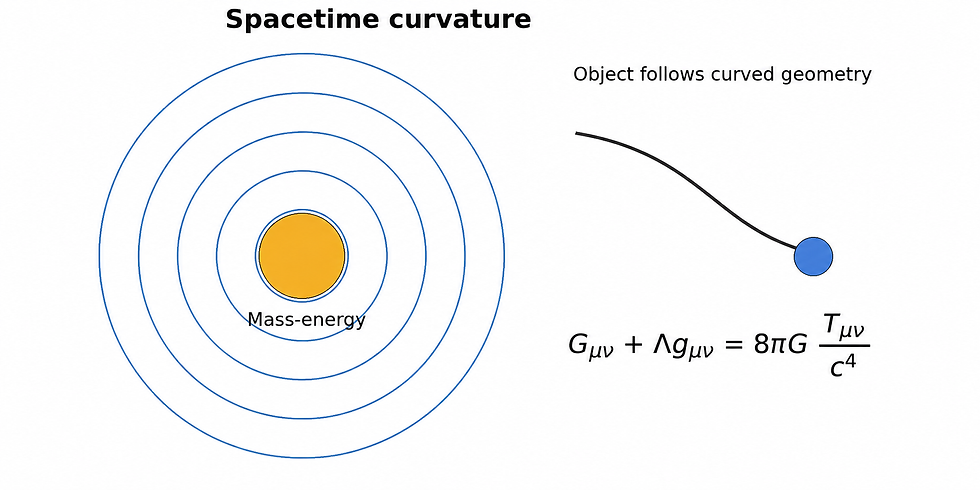
Gravity may have a deeper physical origin beyond the classical description. General Relativity already provides a highly successful geometric description: matter and energy affect spacetime geometry, and free bodies follow paths determined by that geometry.
Hypothesis. Gravity may emerge from a deeper underlying theory. General Relativity would remain the effective large-scale description, while a future quantum theory of gravity could explain the microscopic origin of gravitational phenomena.
Mathematical basis. Gμν + Λgμν = (8πG/c⁴)Tμν.
Evidence. General Relativity is supported by planetary motion, gravitational lensing, gravitational redshift, black-hole observations, and gravitational waves. However, the proposed deeper quantum origin of gravity has not been experimentally established. The hypothetical graviton is one possible quantum description, but no graviton has been directly detected.
Limitations and research direction. The hypothesis needs a specific model that defines the underlying quantum degrees of freedom, recovers General Relativity at large scales, and produces a measurable prediction different from existing theories.
Conclusion. Gravity’s spacetime description is established physics. The search for a deeper quantum explanation remains an open research problem.
Orbital Motion Hypothesis

An orbit results from gravitational attraction acting on an object that already has velocity. Gravity continually changes the direction of the velocity, while forward motion prevents the object from simply falling straight into the central body.
Hypothesis. Stable orbital motion requires both gravitational interaction and suitable initial velocity. Gravity alone does not fully describe why a planet travels around a star instead of moving directly toward it.
Mathematical basis. F = GMm/r²
For a circular orbit: GM/r² = v²/r, therefore v = √(GM/r).
Evidence. Orbital dynamics are strongly supported by observations of planets, moons, artificial satellites, binary stars, and other systems. Newtonian mechanics is an accurate approximation in weak fields and low speeds; General Relativity supplies corrections in stronger fields or high-precision situations.
Limitations and research direction. Real orbits may be elliptical and affected by perturbations, additional bodies, and relativistic corrections. A useful extension is to compare the same orbit using Newtonian and relativistic models.
Conclusion. The idea is consistent with established orbital mechanics and is best described as an intuitive formulation of known physics.
Black-Hole Collision and Wormhole Hypothesis
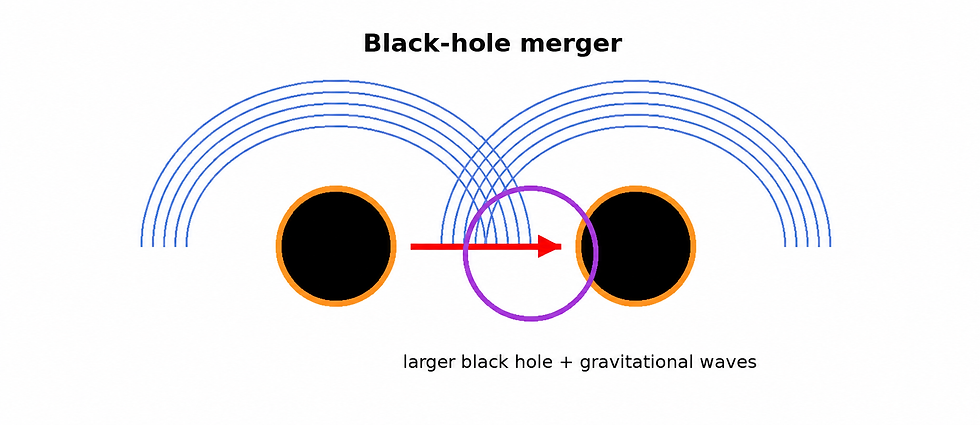
This hypothesis explores whether a collision or merger of black holes could be connected with the formation of a wormhole or a shortcut between distant regions of spacetime. Black-hole mergers are established astrophysical events, but a stable, traversable wormhole produced by such a merger has not been demonstrated. It should be noted that black-hole event horizons are not known to be an entrance to a tunnel. Mathematical bridge structures do not automatically imply a physical, stable, traversable exit.
Hypothesis. Under some unknown physical conditions, the extreme spacetime geometry associated with a black-hole merger might produce a bridge-like connection between distant spacetime regions. This proposal is explicitly speculative.
Mathematical basis. General Relativity admits mathematical geometries containing Einstein-Rosen bridge structures in certain idealized solutions. However, a mathematical bridge does not establish that a realistic merger creates a stable or traversable wormhole. A traversable model would require a spacetime metric, a physically acceptable stress-energy source, and a stability analysis.
Evidence. Gravitational-wave observations have established black-hole mergers. No confirmed observation has shown that a black-hole merger produces a traversable wormhole.
Limitations and research direction. The hypothesis needs a quantitative merger model and a prediction that distinguishes a wormhole from an ordinary post-merger black hole. Possible investigations include causal structure, stability, gravitational-wave signatures, and realistic astrophysical conditions.
Conclusion. Black-hole mergers are real and well supported. The claim that they create usable wormholes is not established and remains a theoretical question.
Gravity, Mass Distribution and Buoyancy Hypothesis
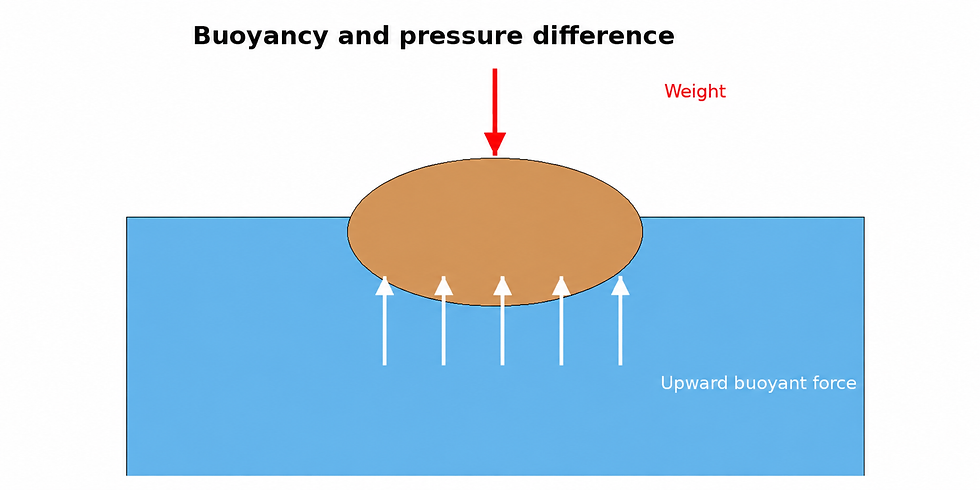
This hypothesis began from the observation that an object can float in water and asks whether mass distribution has a connection with the behavior of matter in a gravitational field. The established explanation of buoyancy is pressure variation in a fluid, summarized by Archimedes’ principle.
Hypothesis. An object’s total mass and volume determine its average density and influence whether it can float, while the distribution of mass within the object can affect its orientation and stability. The amount of fluid displaced by the object is governed by the balance between the object’s weight and the buoyant force. The proposal that floating occurs because an object cannot bend spacetime is not supported by established physics.
Mathematical basis. Fb = ρf g Vd
Fb is the buoyant force, ρf is the density of the surrounding fluid, g is the acceleration due to gravity, and Vd is the volume of fluid displaced by the object. An object floats when the upward buoyant force can balance its weight under the relevant conditions. Average density and displaced volume are central quantities. Mass distribution affects stability and orientation, but does not play the central role.
Evidence. Buoyancy follows from the pressure gradient in a fluid under gravity. The standard derivation does not require an assumption that an object is unable to curve spacetime. Ordinary objects do contribute to spacetime curvature, but the effect is extremely small and is not the mechanism responsible for floating.
Limitations and research direction. A useful experiment could measure how changes in shape, density distribution, center of mass, and displaced volume affect floating stability. Any proposed relativistic correction would need to be calculated quantitatively.
Conclusion. Mass distribution is relevant to buoyancy-related stability and density, but the spacetime-bending explanation for floating is not supported. The correct foundation is Archimedes’ principle.
Omniversal Web Hypothesis
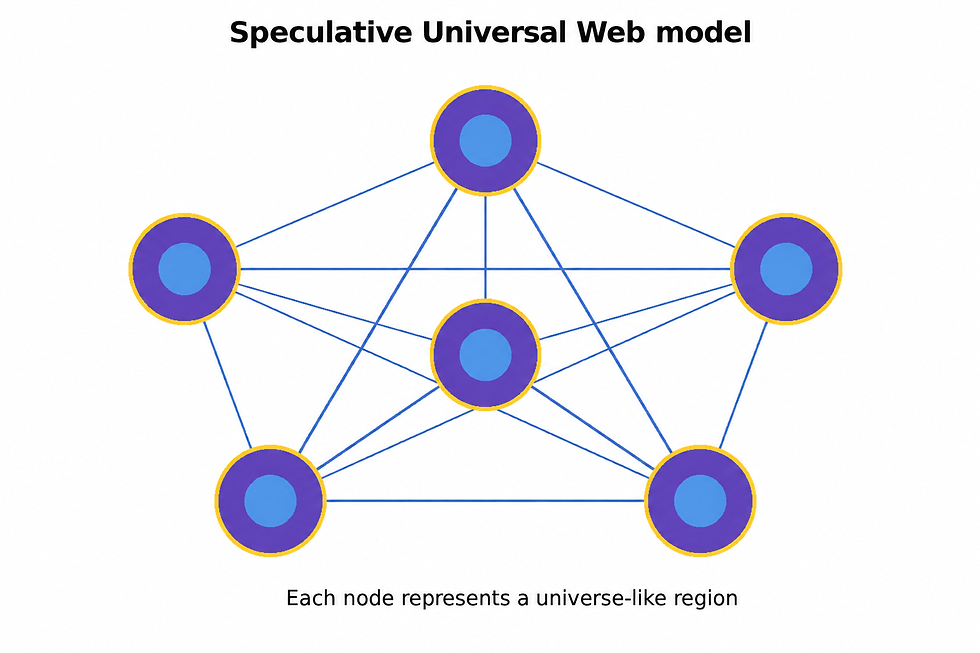
This hypothesis proposes, as a conceptual model, that our universe could be one region within a larger structure containing multiple universe-like regions. The web is imagined as a higher-level connection between these regions. This is a speculative cosmological idea and is not established.
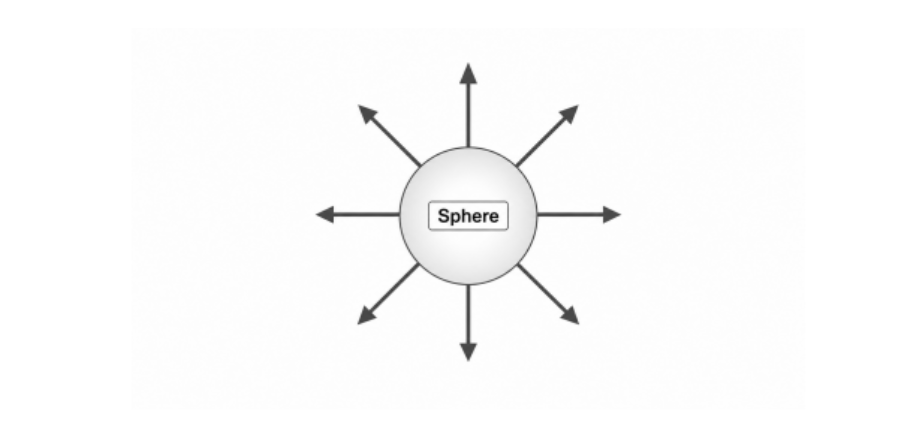
Hypothesis. Universe-like regions may exist as separate nodes of a larger mathematical structure. In the analogy, each node is represented as a ball and the connecting web represents an underlying geometry, field, or extra-dimensional relationship.
Mathematical basis. Cosmological models based on General Relativity use Einstein’s field equations together with assumptions about large-scale homogeneity and isotropy. Friedmann-Lemaître models describe an evolving scale factor a(t). These equations can model an expanding universe, but they do not by themselves prove a multiverse or a web connecting multiple universes.
Evidence. The model can contain cosmic nodes, hypothetical web connections, and a global geometry. Key questions are: What is the web mathematically?, Can information or energy pass between nodes?, What conservation laws would apply?, Could the model produce an observable signature?, and so on. There is no confirmed observational evidence for an Omniversal Web. Expansion of our universe is established, but the step from expansion to a network of multiple universes is an additional hypothesis. The ball-and-web image is an analogy, not a physical proof.
Limitations and research direction. The hypothesis needs a defined mathematical framework, initial conditions, dynamical equations, and falsifiable predictions. A next step would be to investigate whether a higher-dimensional or field-based model can reproduce known observations while predicting a new measurable effect.
Conclusion. The Omniversal Web is best treated as a speculative thought experiment that may generate precise questions about spacetime and cosmology.
Comparative Discussion
The five topics do not have the same scientific status. Gravity in General Relativity, orbital mechanics, and buoyancy are established areas of physics with extensive mathematical and observational support. The proposed deeper quantum origin of gravity is an open research question. The black hole/wormhole connection and the Omniversal Web are substantially more speculative.
Topic | Status | Main basis | What would strengthen it? |
Gravity and spacetime | Established framework; open quantum question | Einstein field equations | A tested quantum-gravity model |
Orbital motion | Established physics | F = GMm/r² | Higher-precision and relativistic modelling |
Black-hole merger to wormhole | Speculative | General-relativistic geometry | Specific metric and testable signature |
Mass distribution and buoyancy | Buoyancy established; mass-distribution hypothesis not | Fb = ρf g Vd | Controlled experiments |
Omniversal Web | Highly speculative | Cosmological GR equations | Defined mathematics and falsifiable prediction |
Conclusion
The main point of this article is separating what is already known from what is being proposed. General Relativity gives a powerful description of gravitation and spacetime; orbital mechanics explains how gravitational attraction and velocity produce trajectories; and Archimedes’ principle explains buoyancy. The remaining ideas: black-hole mergers as possible wormhole generators and a larger Omniversal Web, require substantially more mathematical development and observational testing. A productive next stage would be to choose one speculative hypothesis, define its variables, write a mathematical model, derive consequences, compare them with existing observations, and identify a prediction that could falsify the model.
References
[1] Einstein, A. (1916). The Foundation of the General Theory of Relativity. Annalen der Physik, 49, 769–822.
[2] Schwarzschild, K. (1916). On the Gravitational Field of a Mass Point According to Einstein’s Theory. Sitzungsberichte der Königlich Preussischen Akademie der Wissenschaften.
[3] Morris, M. S., & Thorne, K. S. (1988). Wormholes in spacetime and their use for interstellar travel. American Journal of Physics, 56(5), 395–412.
[4] Abbott, B. P., et al. (2016). Observation of Gravitational Waves from a Binary Black Hole Merger. Physical Review Letters, 116, 061102.
[5] Archimedes. On Floating Bodies. Classical work underlying the principle of buoyancy.
[6] Friedmann, A. (1922). On the Curvature of Space. Zeitschrift für Physik, 10, 377–386.
[7] Lemaître, G. (1927). A homogeneous universe of constant mass and increasing radius accounting for the radial velocity of extragalactic nebulae. Annales de la Société Scientifique de Bruxelles, 47, 49–59.

Comments