
.png)


From Bandgaps to Molten Salt: The Physics of Solar Dominance

Author: Kavya Upadhyay
Introduction
Consider an unassuming device situated on a rooftop, silently converting the most abundant resource in the solar system, sunlight, into the electrical energy that powers appliances, lighting, and electronic devices. While this process may appear almost magical, it is, in fact, rooted in one of the most intriguing and practically significant applications of quantum physics: the photovoltaic effect.
In an era where clean energy has become increasingly critical, solar panels have emerged as a prominent symbol of a sustainable future. Beneath their sleek, glass-covered surface lies a complex system of atomic interactions. The primary material, silicon, is derived from silica, the main component of common beach sand. Through an intricate engineering process, this material is transformed into a semiconductor capable of capturing a photon's energy and liberating an electron.
To contextualize the scale of solar energy availability, consider the following statistic: the amount of sunlight that reaches the Earth's surface in approximately one and a half hours is sufficient to meet the entire world's annual energy consumption.
Solar technologies capture this energy through two principal methods. Photovoltaic (PV) panels convert sunlight directly into electricity. Concentrating solar-thermal power (CSP) systems, conversely, employ mirrors to focus solar radiation and generate heat, which is subsequently used to produce electricity. In both cases, the energy may either be utilized immediately or stored as thermal energy for later use.
Photovoltaics: The Mechanism Behind the Glass
Photovoltaic (PV) cells constitute the core functional component of solar panels. When sunlight strikes a panel, the PV cells absorb the incident energy, generating electric charges that propagate through the cell and produce an electrical current. A more detailed examination of this process reveals the underlying physical principles.
A PV cell is composed of a semiconductor material. The term "semiconductor" indicates that the material conducts electricity more readily than an insulator but less efficiently than a metallic conductor. When light encounters the cell, it may be reflected, absorbed, or transmitted through the material. The objective is to maximize absorption. When the semiconductor absorbs light, it transfers energy to electrons within the material. This additional energy provides the impetus required for electrons to flow through the material, thereby generating an electrical current. This current is subsequently collected by the metallic grid lines visible on the surface of a solar cell and directed to power external systems.

A critical concept in this context is the bandgap. A material property that determines which wavelengths of light a given semiconductor can absorb. When the bandgap aligns appropriately with the incident sunlight, efficient energy conversion is achieved. Mismatch between bandgap and the solar spectrum results in suboptimal energy utilization.
A Survey of Solar Materials
Silicon currently dominates the photovoltaic industry, being utilized in approximately 95% of all modules manufactured today. Its well-ordered crystalline structure facilitates efficient conversion of light into electricity. Silicon cells achieve a notable balance among high performance, low manufacturing cost, and exceptional durability, typically maintaining over 80% of their original power output after 25 years of operation.
Several thin-film technologies offer alternative approaches. Cadmium telluride (CdTe) represents the second most prevalent PV material; while less expensive to manufacture than silicon, it exhibits somewhat lower conversion efficiency. Copper indium gallium diselenide (CIGS) demonstrates impressive performance under laboratory conditions; however, manufacturing it on a large scale is challenging because it requires combining four different elements.
Perovskite solar cells have garnered considerable attention for exhibiting the most rapid efficiency improvement of any PV material in history, progressing from approximately 3% efficiency in 2009 to over 25% by 2020. Nevertheless, a substantial obstacle remains: demonstrating long-term operational stability over decades of outdoor exposure before commercial viability can be established.
Organic photovoltaics employ carbon-based compounds and offer the advantages of flexibility and low-cost production. However, their efficiency is approximately half that of silicon cells, and their operational longevity is comparatively limited. Quantum dot cells utilize semiconductor particles on the nanometer scale, offering customizable bandgap properties - a theoretically appealing characteristic. However, achieving effective electrical connectivity between these quantum dots remains technically challenging, and their efficiency currently lags behind that of established technologies.
Multijunction and Concentrating Architectures
For applications that need the highest possible efficiency, multiple semiconductor layers can be stacked on top of one another. These devices are called multijunction solar cells. Each layer absorbs a different part of the solar spectrum. This method has set record conversion efficiencies above 45%. However, the complexity and cost of making them limits their use to specialized applications like spacecraft and military drones, where performance matters more than cost.
It is worth noting that silicon is an incredibly important material in modern technology. Because it is so common, people may not fully appreciate it. But its ability to work reliably for 25 years or more at such a low cost is truly impressive. Meanwhile, perovskite technology has a very interesting story. It has improved faster than any other PV material. This raises the question of whether we are seeing the beginning of a real solar revolution or just a passing trend. In either case, the diversity of photovoltaic technologies shows that solar energy encompasses not a single technology but an entire family of approaches, each competing to establish its niche.
Concentrating Solar Power: Thermal Conversion via Mirrors
Whereas photovoltaics convert sunlight directly into electricity, concentrating solar-thermal power (CSP) employs an indirect but effective methodology. Rather than relying on semiconductor materials, CSP systems utilize mirrors to reflect and concentrate sunlight onto receivers, which collect the incident energy as heat. This thermal energy may then be used to generate electricity or stored for subsequent use. In essence, CSP harnesses solar radiation to heat a working fluid, analogous to boiling water, but at utility scale. CSP systems are predominantly deployed in large-scale power plants capable of supplying electricity to thousands of households. The principal configuration is the linear concentrating system.
The Mechanism of Linear CSP
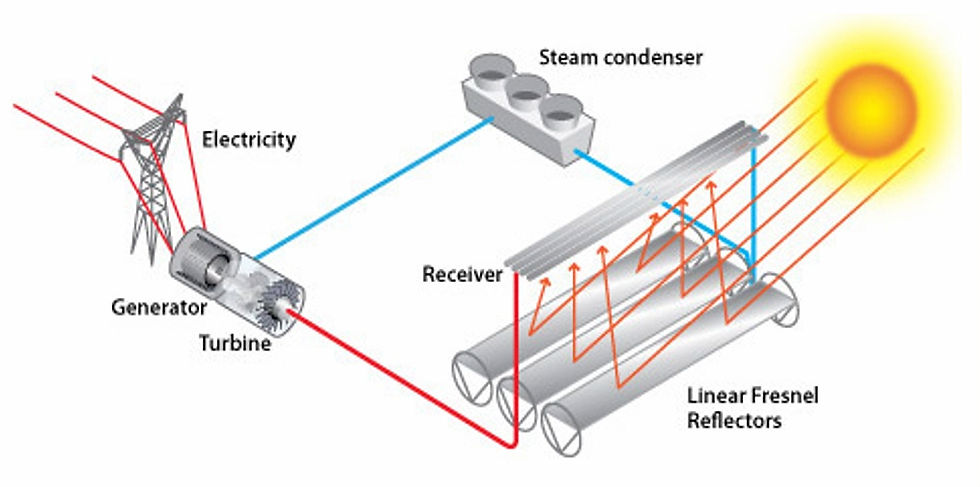
Linear concentrating systems employ long, rectangular mirrors to focus sunlight onto a receiver tube positioned along the mirrors' focal axis. Within this tube flows a heat transfer fluid. As concentrated sunlight heats this fluid, the thermal energy is transported to a power block, where it generates steam. This steam drives a turbine connected to a generator, thereby producing electricity.
In certain configurations, steam may be generated directly within the solar field, eliminating the need for heat exchangers and reducing hardware costs. The mirrors are typically arranged in long, parallel rows, oriented north-south. A single-axis tracking system enables the mirrors to follow the sun's east-to-west trajectory throughout the day, maintaining continuous concentration of sunlight onto the receiver tubes.
Thermal Energy Storage
A particularly advantageous feature of linear CSP systems is their capacity for thermal energy storage. By constructing a collector field larger than necessary for immediate power generation, these systems can heat a storage medium, commonly molten salt, during daylight hours. This stored thermal energy can subsequently be used to generate steam and produce electricity after sunset. Thus, electrical power may be supplied long after the solar energy was originally captured.
CSP systems may also be designed as hybrid plants, incorporating fossil fuel backup to supplement solar output during periods of insufficient sunlight. A natural gas-fired heater or gas-steam boiler can be engaged as needed to ensure consistent power generation. Looking forward, CSP technology may potentially be integrated with existing natural gas and coal fired power plants, thereby extending the utility of established infrastructure while incorporating renewable energy.
Varieties of Linear CSP
Linear CSP systems are implemented in two principal configurations:
1. Parabolic Troughs: This configuration is the most widely deployed. Each mirror is shaped as a parabola, with the receiver tube positioned along its focal line. The tube is fixed to the mirror structure, and the entire assembly tilts in unison to track the sun. Heat transfer fluid circulates through the tubes across the entire field, collecting thermal energy before proceeding to the power block for steam generation. This design is characterized by its simplicity, reliability, and proven scalability.

2. Linear Fresnel Reflectors: This configuration employs long, flat or slightly curved mirrors mounted on ground-based trackers. Rather than a single parabolic structure, multiple smaller mirrors operate in concert, reflecting sunlight upward to a receiver tube suspended above them. In some implementations, a secondary parabolic mirror is positioned above the receiver to further concentrate the incident light, thereby enhancing overall efficiency.
The Big Picture
CSP presents a notably distinct character compared to photovoltaics. PV panels operate silently and with no visible movement; CSP, by contrast, involves conspicuous mechanical activity. Acres of mirrors tilting in coordinated motion, tracking the sun's path throughout the day. The use of molten salt for thermal storage constitutes a remarkably effective solution to solar energy's intermittency problem, obviating the need for expensive battery systems. However, CSP requires extensive land area and direct sunlight, which explains its predominant deployment in desert regions. While CSP is unlikely to supersede photovoltaics in the near term, it occupies a unique niche: providing grid-scale power that remains available after dark.
Conclusion: Complementary Technologies, Shared Objective
The question of whether photovoltaics or concentrating solar power is superior admits a nuanced answer: both technologies are valuable, and they are better understood as complementary rather than competitive solutions to distinct challenges.
PV panels function as quiet workhorses. Deployed on rooftops and in solar farms, they convert sunlight directly into electricity with no moving parts, no acoustic emissions, and minimal operational complexity. Their scalability is remarkable, enabling applications ranging from powering a single calculator to supplying an entire neighborhood. Their declining cost has enabled millions of households worldwide to generate their own electricity.
CSP, by contrast, occupies the role of a heavyweight solution. It requires expansive land areas and direct solar irradiation, but it offers a capability that photovoltaics currently lacks: integrated, large-scale energy storage. The ability to capture thermal energy at midday and convert it to electricity at midnight renders CSP a valuable tool for grid stability. It does not seek to compete with rooftop solar panels; rather, it aims to function as the power plant that continues generating electricity after sunset.
Taken together, these technologies demonstrate that solar energy is not a monolithic solution but a versatile toolkit. Some contexts call for silicon wafers; others require extensive mirror fields and tanks of molten salt. Both approaches ultimately serve the same purpose: harnessing sunlight to power a world increasingly in need of cleaner energy sources.
Bibliography
U.S. Department of Energy. "Concentrating Solar-Thermal Power Basics." Accessed April 28, 2026. https://www.energy.gov/eere/solar/concentrating-solar-thermal-power-basics.
U.S. Department of Energy. "Linear Concentrator System Concentrating Solar-Thermal Power Basics." Accessed April 28, 2026. https://www.energy.gov/eere/solar/linear-concentrator-system-concentrating-solar-thermal-power-basics.
U.S. Department of Energy. "Solar Photovoltaic Cell Basics." Accessed April 28, 2026. https://www.energy.gov/eere/solar/solar-photovoltaic-cell-basics.
ScienceDirect by Elsevier. "Solar Energy Materials and Solar Cells." Journal. Accessed April 28, 2026. https://www.sciencedirect.com/journal/solar-energy-materials-and-solar-cells.


Comments