
.png)


Why Airplanes Don’t Fall: The Physics of Flight

Author: Aahana Krishna
Aircraft remain airborne through the precise interaction of four fundamental forces: weight, lift, drag, and thrust. This article examines how these forces work in dynamic equilibrium to enable flight, drawing from established aerodynamic principles and engineering practice.
Introduction
Every day, millions of passengers board aircraft weighing hundreds of tons and soar through the sky with remarkable safety and efficiency. Yet despite over a century of powered flight, misconceptions about how aircraft remain airborne persist in popular understanding. As Wild (2023) notes in reviewing flight education literature, "if you read popular sources, you would believe 'no one can explain why planes stay in the air'" - a disconcerting thought while sitting in a modern Boeing or Airbus. The reality is that the principles of flight are well-established in physics and engineering. Aircraft remain airborne through the precise interaction of four fundamental forces: weight, lift, drag, and thrust. These forces and their interrelationships govern all flight, from natural flyers to modern commercial aircraft.
Understanding these principles requires examining both the historical development of aerodynamic theory and its practical application. The field has evolved from early theoretical work by mathematicians like Euler and Laplace, who developed fundamental equations independently from a variety of sources and without immediate practical application, to the hands-on experimentation of pioneers like the Wright brothers, who had no advanced degrees and no outside funders.
Fundamental Forces of Flight
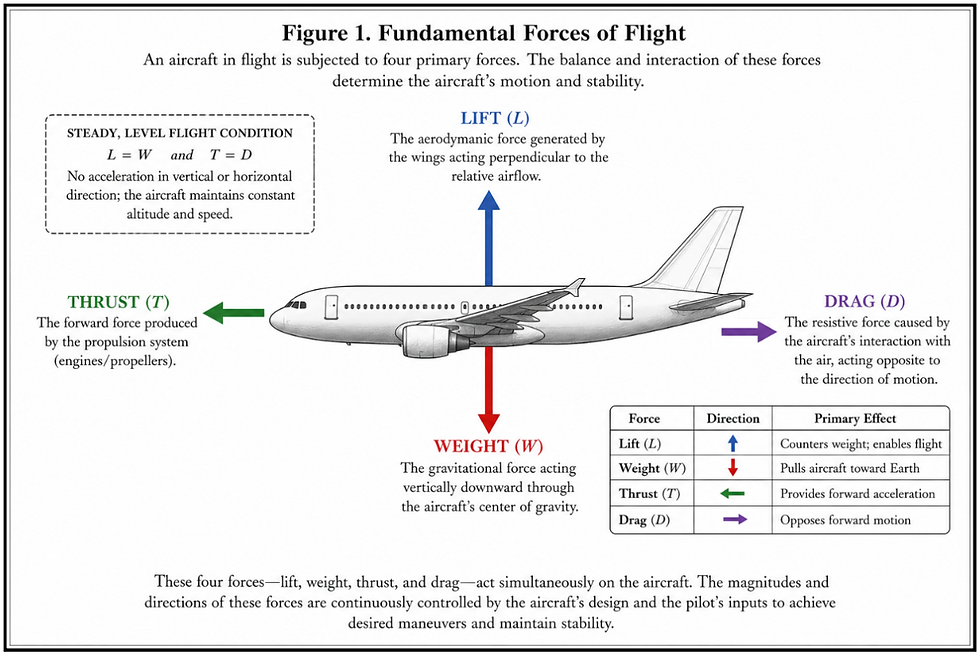
The four forces that govern flight are weight, lift, drag, and thrust, each playing a critical role in aircraft operation. These forces must work in precise balance for sustained flight to occur.
Weight acts downward on the aircraft due to gravitational force. This includes the mass of the aircraft structure, fuel, passengers, and cargo.
Lift is the upward force that counteracts weight. It is generated primarily by the wings through aerodynamic principles involving pressure differences across the wing surfaces. The equation governing lift is:
L = ½ ρ v² S CL
where ρ is air density, v is velocity, S is wing surface area, and CL is the lift coefficient.
Drag opposes the aircraft's forward motion through the air. Drag is the opposing force acting on an aircraft due to the gases in the air, and greatly depends on the shape of the wings of the aircraft. The drag equation follows:
D = ½ ρ v² S CD
where CD is the drag coefficient.
Thrust provides the forward force necessary to overcome drag and maintain airspeed. Propulsive devices generate thrust by ensuring that the momentum exiting the propulsive device far exceeds the momentum entering the propulsive device.
Principle of Flight
The fundamental principle underlying flight involves the generation of circulation around the wing due to viscosity. Wings generate lift through viscosity-induced circulation in the airflow around them, creating asymmetric pressure distribution, while propulsive devices produce thrust by accelerating air mass.
This circulation is not arbitrary but results from specific physical mechanisms. The boundary layer is a thin layer of air touching the wing's surface, and viscous effects are concentrated in the boundary layer. Outside this boundary layer, the flow can be analyzed using inviscid flow principles, but the boundary layer's influence creates the asymmetric flow pattern essential for lift generation.
The process involves several steps: when air encounters the wing, it must flow around this obstacle, creating pressure gradients. The wing shape and angle of attack, together with circulation established by the viscous effects in the boundary layer, produce faster flow over much of the upper surface than below. This velocity difference, combined with Bernoulli's principle, results in lower pressure above the wing and higher pressure below, creating the net upward force we call lift.
Role of Thrust and Drag
Thrust and drag represent the horizontal force couple in flight dynamics. Thrust must overcome drag to maintain forward motion, while the specific balance between these forces determines whether an aircraft accelerates, maintains constant speed, or decelerates.
Modern aircraft achieve thrust through various propulsive devices: propellers, turbojets, turbofans, ramjets, scramjets, and rockets all operate on the principle of momentum transfer, where the momentum exiting the propulsive device far exceeds the momentum entering.
Drag manifests in multiple forms: induced drag (a byproduct of lift generation), parasitic drag (from air friction over surfaces), and form drag (from the aircraft's shape disrupting airflow). The streamlined shape of an aircraft body is a major factor in determining the drag force, which highlights the importance of aerodynamic design in minimizing resistance.
Balance of Forces and Flight Stability
For an aircraft to maintain steady level flight, the four forces must be in equilibrium: lift equals weight, and thrust equals drag. However, this balance is dynamic rather than static, constantly adjusted through pilot inputs and aircraft control systems.
Performance, stability, dynamics, and control interact in aircraft design. The aircraft's ability to maintain stable flight depends on its design characteristics and the pilot's or autopilot's ability to make continuous adjustments.
When forces are unbalanced, the aircraft experiences acceleration in the direction of the net force. If lift exceeds weight, the aircraft climbs, and vice versa. If thrust exceeds drag, it accelerates forward, and vice versa. This principle allows pilots to control the aircraft's flight path by manipulating these force relationships through control surface deflections and engine power settings.

Factors Affecting Flight
Multiple factors influence an aircraft's ability to generate the necessary forces for flight. Air density, which varies with altitude and temperature, directly affects both lift and drag generation.
Angle of attack, the angle between the wing and the relative airflow, critically affects lift production. There is a critical angle of attack beyond which a stalling condition occurs, as airflow separates from the wing and the coefficient of lift begins to decrease.
Wing design features such as flaps and slats allow pilots to modify the wing's characteristics for different flight phases. These high-lift devices help reduce the stalling speed of an aircraft wing at a given weight, and are particularly important during takeoff and landing.
Real-World Applications
The principles of flight find application across diverse aircraft types, from small general aviation aircraft to large commercial jets and military fighter aircrafts. Each application requires specific optimization of the force balance.
Commercial aviation demonstrates these principles on a massive scale. Modern aircraft like the Boeing 787 and Airbus A350 were designed using advanced computational fluid dynamics based on the Navier-Stokes equations, which can be described as Newton's laws of motion applied correctly to a fluid, including viscosity.
Fighter aircraft present unique challenges, as many fighter jets have a very high thrust-to-weight ratio, sometimes approaching or exceeding 1 depending on the aircraft and loading. This helps them maneuver sharply, accelerate quickly, and maintain control in extreme flight conditions that would be impossible or unsafe for commercial aircraft.
Conclusion
Aircraft remain airborne because four fundamental forces - weight, lift, drag, and thrust - work in carefully managed equilibrium. The generation of lift through viscosity-induced circulation and asymmetric pressure distribution, combined with thrust production through momentum transfer, enables sustained flight.
References and Bibliography
Primary Sources:
[1] Harikumar, A., & Vibhute, V. (2020). Aerodynamic Principles for Aircraft: A Study. International Journal for Research in Applied Science and Engineering Technology, 8(7), 1548-1554. https://doi.org/10.22214/ijraset.2020.30573.
[2] Pamadi, B. N. (2015). Performance, Stability, Dynamics, and Control of Airplanes (3rd ed.). American Institute of Aeronautics and Astronautics.
[3] Wild, G. (2023). Misunderstanding Flight Part 1: A Century of Flight and Lift Education Literature. Education Sciences, 13(8), 762. https://doi.org/10.3390/educsci13080762.
[4] Hu, H., Shyy, W., & Shih, T. (2010). Lift, Thrust and Flight. In R. Blockley & W. Shyy (Eds.), Encyclopedia of Aerospace Engineering (pp. 837-844). John Wiley & Sons.
Supporting Sources:
[5] Auerbach, D. (2000). Why aircraft fly. European Journal of Physics, 21(4), 289-296. https://doi.org/10.1088/0143-0807/21/4/302.
[6] Karmali, F., & Shelhamer, M. (2008). The dynamics of parabolic flight: Flight characteristics and passenger percepts. Acta Astronautica, 63(5-6), 594-602. https://doi.org/10.1016/j.actaastro.2008.04.009.
[7] Yechout, T. R., Morris, S. L., Bossert, D. E., & Hallgren, W. F. (2003). Introduction to Aircraft Flight Mechanics: Performance, Static Stability, Dynamic Stability, and Classical Feedback Control. American Institute of Aeronautics and Astronautics.
[8] Green, M. W. (1925). Determination of the lift and drag characteristics of an airplane in flight. National Advisory Committee for Aeronautics, Technical Note No. 223. NASA.
[9] Launius, R. D. (1999). Review of A History of Aerodynamics and Its Impact on Flying Machines, by John D. Anderson Jr. Technology and Culture, 40(3), 688-690.


Comments