
.png)


A Journey from Thermodynamics to Relativity

Author: Bruna Soares Lopes Moreira
Thermodynamics and the beginning of everything
Thermodynamics, at first glance, might sound quite scary, right? However, have you ever tried to notice what is the real player behind thermodynamics? If I could describe thermodynamics in one word, I would say, without a doubt, energy.
When we put two objects with different temperatures together, common sense tells us that there is a spontaneous energy transfer between them. We know that the hotter object will naturally transfer energy to the cooler one until both of them remain at the same temperature overall. We then say the system has reached thermal equilibrium.
We call this energy moving from one place to another “heat.” It wasn’t always like that, though. At first, this was known as “caloric,” an invisible substance that was thought to move from one object to another. We now know that this doesn’t really happen like that. Actually, scientists such as Benjamin Thompson and James Prescott Joule questioned this, helping establish the modern understanding of heat as energy transfer. Joule also showed that work can cause a change in internal energy, increasing or decreasing the temperature of bodies.
Let’s picture all of this in a quite visual way. Let’s imagine that we have two cans isolated from the surroundings, and inside them we have beans. Both of the cans have the same volume. However, the beans are more excited in the can called A than in the can called B.
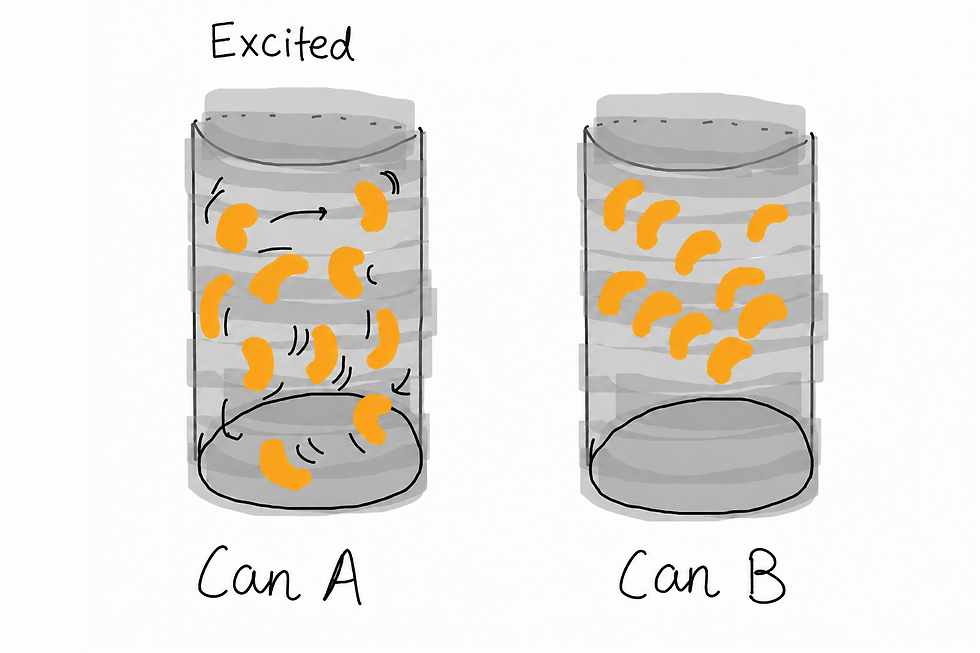
If we ignore the energy exchanges between our system and the outdoors, and we could mix the beans together, do you have any idea about what would happen? Well, the most excited beans would have a greater chance of colliding with the less excited ones. While these collisions are happening, the beans would transfer energy, so the more excited beans would, on average, lose energy while the less excited beans would gain energy. So then both types of beans would become equally excited and we would get to the “beans thermal equilibrium.”
The reader might be asking: why wouldn’t it be the opposite? Why couldn’t the less excited beans “give” their energy to the most excited ones? Then, we are talking about probabilities. They could; they might do it, actually. However, overall, the more probable evolution is toward equilibrium rather than away from it.
Let’s clear up all of this. We know that both of the cans had the same volume and the same dimensions as well. Also, let us assume they were made of the same material. However, this alone does not mean that the contents have the same internal energy. Internal energy includes the microscopic kinetic and potential energies of the particles in a system.
So why wouldn’t both cans have the same internal energy? In our simple picture, kinetic energy is related to the movement of the beans, and the beans in A are more excited. Therefore, their average kinetic energy is greater than that of the beans in B. So, assuming there is no relevant difference in their interaction energies, A has greater internal energy than B.
Let’s forget the beans for now, and let’s think about atoms. Atoms make up the ordinary matter around us; they are part of almost everything we have, touch, and see. I am assuming that you know what an atom is, so let’s think about the beans as atoms now. Let’s not forget that the “A beans” have greater kinetic energy compared to the “B beans.”
So, when we bring both cans into contact, what could actually happen? As we have seen:
A atoms would exchange energy with B atoms.
B atoms would exchange energy with A atoms.
At the microscopic level, it is not impossible for fluctuations to temporarily transfer energy in the opposite direction - for a hotter system to gain some energy from a cooler one. The cooler system would then become even cooler since it had “given” some of its energy. For macroscopic systems, however, such an overall transfer is extremely improbable, as we discussed earlier. This idea is discussed in the book “Seven Brief Lessons on Physics”, by Carlo Rovelli, which is a book that I highly recommend, by the way.
Whether or not you are a physics student, you have probably already heard that thermodynamics has its own laws. We shall discuss some of them in order to take our discussion further. The zeroth law of thermodynamics states that when two bodies are each in thermal equilibrium with a third body, they are also in thermal equilibrium with one another, meaning that they are all at the same temperature. You might find it interesting to see this in a visual way, as we have done with the beans.
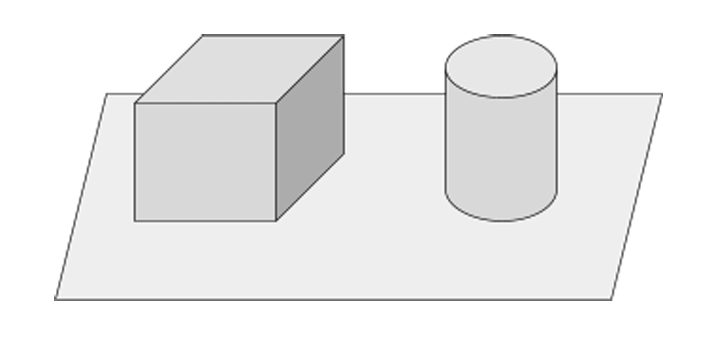
Basically, we have a cube and a cylinder which are both in thermal equilibrium with the surface. So, by the zeroth law of thermodynamics, they also have to be at the same temperature.
It is known that energy has some peculiar characteristics: it is neither destroyed nor created. We can only transform it from one form to another or transfer it between systems. For ordinary thermodynamic systems, energy is conserved, although defining a total conserved energy for the entire expanding Universe is more subtle. Entropy is different, though. Well, I might have spilled the beans too early, haven’t I?
Since I perhaps have, let’s now talk about entropy! Entropy is related to the number of possible microscopic configurations of a system, meaning the possible ways its particles can be arranged while giving the same macroscopic state. In a quite rudimentary way, we can associate higher entropy with more disorder (chaos) or a larger number of possible arrangements.
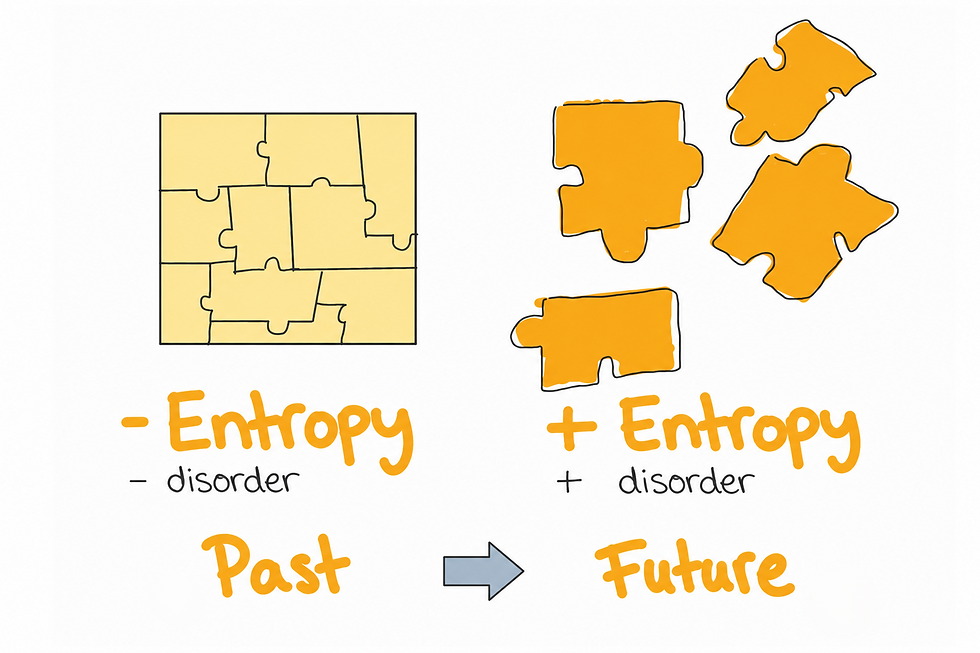
Both the first and second laws of thermodynamics approach these topics. The first one, also known as the “law of conservation of energy,” claims that energy can neither be created nor destroyed, but can be transferred or transformed. We can also claim that the variation of the internal energy (∆U) of a body equals the energy gained or lost in the form of work (W) or heat (Q), both known as energy exchange processes. Using the convention that W is the work done on the system, we can write ∆U = Q + W. For an isolated thermodynamic system, the total energy remains constant. For the entire expanding Universe, however, defining a globally conserved total energy is more subtle.
What do you think, based on this first law, would happen if you could add together all the energy exchanges within an isolated system? The total change in energy would obviously be zero. Because if this result were less than zero, then energy could be destroyed, and if it were greater than zero, then energy would have to be created! That’s not possible. That’s why the first law of Thermodynamics makes so much sense.
Now, what does the second law tell us? It claims, in spite of me having already spilled the beans, that the total entropy of an isolated system cannot decrease. In irreversible processes, entropy increases, while in an ideal reversible process it remains constant. So, for ordinary irreversible macroscopic processes, entropy at a later time is generally greater than it was at an earlier time.
Today’s entropy can therefore be greater than yesterday’s as irreversible processes occur. That happens because natural processes often involve energy dissipation, in which energy becomes more spread out among the possible microscopic configurations of a system and its surroundings, increasing the entropy.
If we think about where that dissipated energy might go, we have many places we could point to, some more astonishing than others. Jupiter, maybe? What matters is that the energy becomes more spread out and less available for useful work, which is associated with an increase in entropy.
All this might be quite confusing, so we might understand it better by “seeing” it.

When you break a glass, you know that when it was untouched, it was in the past, and now that it is broken, you know that’s the future (because it is after the past when the glass was unbroken).
According to thermodynamics, entropy tends to increase, but the glass does not break simply because the Universe “forces” entropy to become greater. Rather, the broken state corresponds to vastly more possible microscopic configurations than the intact state, so the spontaneous reverse process is extraordinarily improbable. There are simply more possible disordered arrangements for the pieces of glass, and therefore greater entropy.
We can now claim that the second law of thermodynamics helps make clear the direction behind many natural processes and how things naturally become older. Energy dissipation is often associated with an increase in entropy, and this is why heat engines and many energy-conversion processes cannot have one hundred percent efficiency. Therefore, entropy production is a natural feature of irreversible processes.
As a system becomes cooler, it becomes even harder to remove more thermal energy from it. That’s why we can never arrive at absolute zero temperature (0 Kelvin) through a finite number of physical processes. This is related to the third law of thermodynamics. In one common formulation, the entropy of a perfect crystal approaches zero as its temperature approaches absolute zero, while absolute zero itself cannot be reached through a finite number of cooling steps.
There was a moment in the history of the Universe when entropy was extraordinarily low: the early Universe around the time of the Big Bang, especially when gravitational degrees of freedom are considered. This is one of the reasons I wrote “the beginning of everything” in the subtitle, because thermodynamics is also deeply related to questions about the Big Bang and the arrow of time.
The arrow of time
I love when science becomes quite philosophical, and that will happen quite a lot in this section. We have just mentioned the Big Bang and the expansion of the Universe. Some of the things we have pointed out earlier make us consider that time has a direction. Why is the future what we call the future and not the past? We guide ourselves mostly because of entropy: if entropy increases, then that’s where the future is going.
However, in spite of being quite weird, time has already been shown not to be universal and absolute. This was first proposed by Albert Einstein in his theory and later confirmed by experiments.
Galileo had defended the relativity of motion. For one person, an airplane might be moving. For a passenger inside the airplane, it might not be moving; it depends on the reference frame.
We can think of some examples:
The Earth is moving relative to the Sun.
A person is not moving relative to the car, which is moving relative to the Moon.
A ball is rolling relative to the floor.
In conclusion, motion is not absolute.
Michael Faraday discovered that a changing magnetic field could generate an electric current, and vice versa. James Clerk Maxwell described the relationship between electric and magnetic fields mathematically and showed that oscillating electric and magnetic fields would propagate as electromagnetic waves at a fixed speed in vacuum. This velocity wasn’t relative, it was absolute, no matter the reference frame, and that was weird. This speed is the velocity of light in vacuum, denoted by c.
Indeed, how could a velocity be constant if we have pointed out that motion isn’t absolute? Einstein thought about that too.
As we know, velocity can be calculated by dividing the distance travelled by the time taken to cover that distance. Knowing that the velocity of light is constant for all inertial observers, we had to accept that distance and time could not absolute, and that each person could measure time differently depending on where they were and at what velocity they were moving.
Let’s think about this with a quite common example: Imagine a tube moving with veloity v relative to an external observer, where light goes to one “wall” and bounces back again to the original wall. Let’s picture that the distance to the first wall is “L” and that the light follows a straight-line trajectory.
We have two different points of view in this case or, in scientific language, we have two different reference frames:
Reference frame S: the tube itself.
Reference frame S’: the tube seen from the outside while travelling at a velocity v.
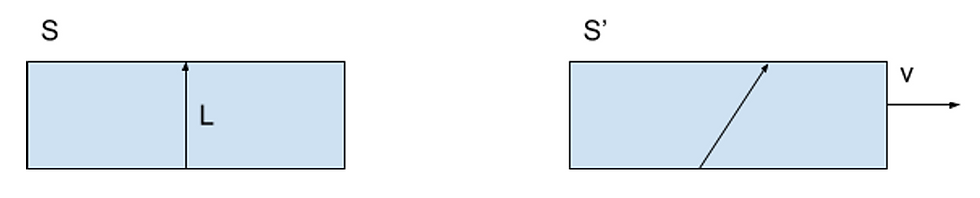
You might be asking why, in S’, light is not following a straight vertical line as in S. That is because the tube is also moving horizontally at v meters per second, and from outside this motion becomes visible to the observer. In S frame, the observer is inside the tube, and from this frame, the tube is not moving.
What’s the difference between the times here? Will they be the same for the two reference frames? Well, they won’t! If c is the velocity of the light, we can write L = ct, because multiplying time by velocity gives us the distance travelled .
Then, what is the distance d travelled by the tube because of its velocity v? Same idea: d = vt’ (because here we have to multiply by the time that has passed in reference frame S’, not S, which we denote by t’). Now we can use the Pythagorean theorem and recognize what the real distance r travelled by light in S’ is:
r² = L² + d² → r² = (ct)² + (vt’)²

However, we know that the distance r will have to be ct’ because the speed of light is constant. Thus,
(ct’)² = (ct)² + (vt’)² → (ct’)² – (vt’)² = (ct)²
c²t’² – v²t’² = c²t² → t’² (c² – v²) = c² t²
t’² = c²t² / (c² – v²) → t’² = c²t² / (c²(1 – v²/c²))
t’² = t / √(1 – v²/c²)
So then we have proved that t’ is different from t, but if velocity v equals zero or has values significantly smaller compared with the speed of light, then the denominator is very close to one and t’ becomes almost equal to t. That’s why we don’t notice relativistic effects in our daily life, because our usual velocities are extremely small compared with the speed of light c, which is 299792458 meters per second!
Let’s picture another situation where a person A is making an astronomical trip for two years, which is approximately 2 × 365 × 24 × 60 × 60 seconds in the refernece frame of this person S (let the time recorded by the person be t). Let us assume this person is travelling at about 75% of the cosmic speed limit - the speed of light. How much time tₑ has passed on Earth? And what would the distance be?
The relationship we obtained above showed that t and t’ weren’t the same, and the factor we use to relate the two reference frames is:
γ = 1 / √(1 – v²/c²)
This is called the Lorentz factor, and we can use it when relating measurements between different reference frames.
So, for the person travelling at 75% the speed of light for two years, we have:
v = 75c / 100 = 0.75c
γ = 1 / √(1 – (0.75c)²/c²) = 1.51186
γ = tₑ / t → γt = tₑ
1.51186 × 2 × 365 × 24 × 60 × 60 = tₑ
tₑ = 9.5356 × 10⁷ seconds = 3.02 Earth years
So, while everybody on Earth experienced 3.02 years, person A experienced just 2 years (he might look younger than the people on Earth would expect!).
Welcome to spacetime!
We have seen that the velocity at which we are moving might introduce differences perceptions of time. However, massive bodies might cause such differences as well. Let’s try this example: two twin brothers, one lives up on a mountain and the other lives on a plain near sea level.
According to the theory of relativity, the man who lives at the peak will be slightly older since time passes faster higher up. That is because massive objects curve spacetime. That’s kinda how gravity works for Einstein, and this effect has been experimentally confirmed!
Carlo Rovelli also discusses this relationship between gravity, spacetime, and time in “Seven Brief Lessons on Physics”, the book I mentioned earlier.
That is exactly what happens between the Earth and the Sun. The Sun is a massive object, so it curves spacetime around it, affecting the trajectory of the Earth. For Einstein, gravity is not described simply as a force, but as a consequence of the curvature of spacetime.
Moreover, this theory also points to the existence of four-dimensional spacetime: three spatial dimensions, which we are quite used to, and one time dimension.
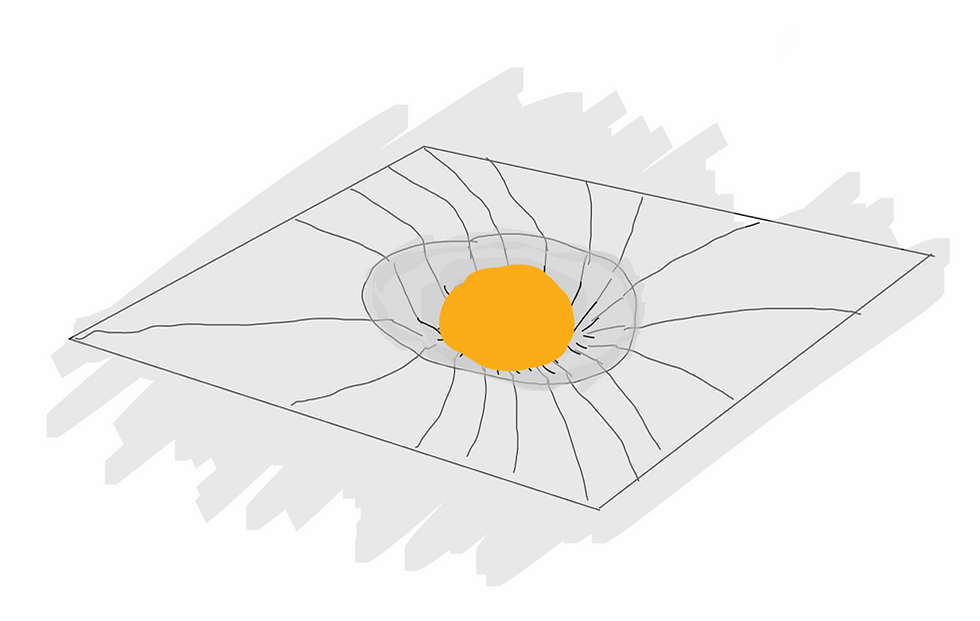
It’s important to point out that Newton’s theory is not wrong. Actually, it accurately describes everyday life and many astronomical situations. However, compared with Newton’s theory, relativity can offer greater precision and correct some limitations, so it is used in situations such as very strong gravitational fields or when highly precise calculations of satellite motion and timing are needed.
The author
Bruna Moreira is a teenager, age 16, from Portugal. She loves learning and going out of her comfort zone. She absolutely loves challenges. She hates rollercoasters, though.
Bruna has a passion for science. She loves the whole atmosphere that science gives her. She loves the feeling of being able to look at everything around her and think, “Which law of physics allows this to happen?” She loves the opportunity we have to talk about science and to learn and listen to science.
Bruna has lots of dreams, having someone reading this is one of them.


Comments