
.png)


Nanotechnology: Small Scales, Big Changes

Author: Apolline Panie
What if the key to revolutionizing medicine and technology lies in particles so small they are measured in billionths of a meter?
Gold is gold… right? Take a second to picture a piece of gold. What color do you see? Probably the familiar shiny yellow. Now imagine making the piece of gold unbelievably small. Would you expect it to stay gold? Surprisingly, it might appear blue, red, or even purple. When particles are reduced to the nanoscale, they behave in unexpected, interesting ways that are difficult to imagine based on our everyday experience. Their interaction with light, magnetic fields, electricity, and other materials can change a lot compared to their normal size. How and why does making something incredibly small change how it behaves? To study that, scientists dive into the world of only one billionth of a meter, where atoms, electrons, and quantum effects become increasingly important. All of this falls under the field of nanotechnology.
So what exactly is nanotechnology?
The nanoscale is the range of dimensions where nanometers become the standard unit. Anything between one and a hundred nanometers is generally considered to be at the nanoscale. A nanometer is one billionth of a meter. For comparison, a human hair’s diameter is approximately a few tens of thousands of nanometers. That means that an object measuring a hundred nanometers would have to be a lot narrower than a human hair. A piece of DNA is roughly a few nanometers wide, and an atom is generally less than one nanometer across. To put that to scale, one nanometer to a size of a meter is like a marble to the Earth.

For a material to be considered nanotechnology, it does not have to be a few nanometers in both diameter and length; for example, a thin film containing nanoscale structures would still be nanotechnology even if it is much larger. Nanoscale represents a structure, not necessarily the size of an object.
Cutting an object in half does not necessarily change any of its properties. But when scientists engineer them at the nanoscale, it changes how atoms interact with each other. Nanotechnology isn’t just interesting because it is tiny; it is interesting because it changes how matter reacts to its surroundings.
When dividing a material into smaller pieces, a larger chunk of material is close to the surface. So similarly, at the nanoscale, a very large number of atoms are closer to the surface. The amount of material stays the same, but the total surface area changes since some of the material that wasn't exposed now is. Atoms at the surface react very differently with their surroundings than atoms deep inside the material. This phenomenon affects the chemical reactions a material can have, reactivity to its environment, and how it interacts with other materials. These effects are one of the reasons nanomaterials behave differently at the nanoscale.

At extremely small dimensions, the changes to how a material behaves become significant. In some nanomaterials, electrons are confined to very small regions, changing their allowed energy levels. This effect is called quantum confinement. It can strongly affect how it interacts with light, electricity, and energy. The quantum effects and surface effects help explain how and why a material can have different properties depending on its size.
What are the actual changes when a material is in the nanoscale?
But so let’s come back to the initial question: How does gold change totally when it is cut down to the nanoscale? When gold is transformed into something so small, its interaction with light switches depending on the particle shape and size, arrangement, and surrounding environment. But what is really happening scientifically? Nanoparticles can interact with light in unusual ways, and this all happens because of LSPR. This stands for Localized Surface Plasmon Resonance. LSPR is when light interacts with electrons on the nanoparticle. Their behavior affects how the wavelengths of light are absorbed and scattered, and changes how the color shows up.
Quantum dots are a material widely used in nanotechnology. They are extremely small semiconductor crystals, often only a few nanometers wide. They contain many atoms, but because they are so small, their electrons are confined to a very small space.
The size of a quantum dot changes how it behaves. For example, a smaller quantum dot has different energy levels than a larger one made from the same material. This affects the way it interacts with light and electricity. Because scientists can control the size of these dots, they can also control some of their properties.
Quantum dots are already used in some display technologies, where their size helps determine the color they produce. But that's not their only use. Researchers are also studying them for solar cells, sensors, and biological imaging. What makes them interesting is that changing something as simple as their size can change the way the material behaves.
The biggest challenge: creating the material
The biggest challenge for scientists is actually creating the nanoscale material. There are two main ways to create nanoscale material. One is using a top-down approach, where you start with a larger part of material, and the other is bottom-up, which is when a scientist starts small and assembles the atoms to make a bigger structure.
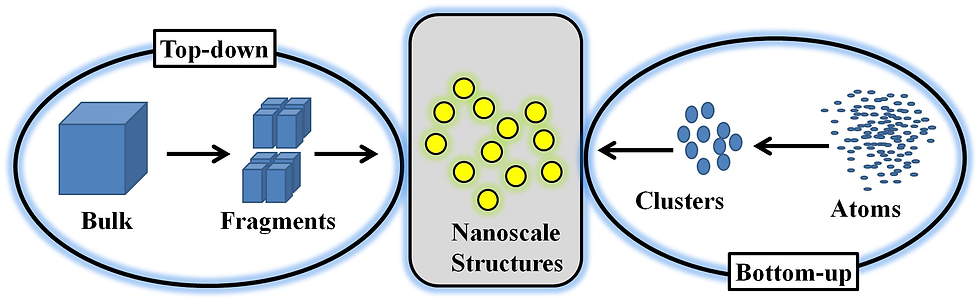
Top-down is often the less expensive approach. It starts with a large piece of material and gradually removes parts of it to leave behind the tiny structure needed. One example of top-down is nanolithography. This involves creating an extremely small pattern on a material. This process creates a pattern by removing material, which is why it is considered a use of the top-down method. This is really important in computer manufacturing because it allows scientists to fit many transistors in a tiny chip and to build circuits.
The other method, bottom-up, can sometimes be more expensive, but is much more precise. It starts with atoms, molecules, and small particles, and they are put together to form a nanomaterial. This method is more precise because these conditions allow scientists to better control the material’s size, shape, and composition.
What do scientists actually do with these materials?
Well, believe it or not, nanotechnology may already be lying in your hands, on your lap, or right in front of you as you use your device. Nanoscale structures allow the components in your tablet, computer, and phone to be incredibly small. This allows more transistors and other small structures to fit into a chip. Nanotechnology is also being explored for sensors and new electronic materials. So, as engineering scientists and researchers control more of the nanoscale world, it can help with more advanced technology.
Nanotechnology is also incredibly useful in renewable energy and the environment. Since it can change how a surface interacts with light, it is being studied to improve solar cells (solar panels) to make them more efficient. Researchers have found that certain nanoscale structures can improve how light interacts with the cell, for example by reducing reflection and/or increasing light absorption. Nanostructured membranes can also help filter contaminants from water. So nanomaterials can interact with and capture the pollutants in the water. This might be a world-changing discovery because, if brought to a lower cost and a wider range, everyone in the world could have drinkable water.
Nanotechnology can also help deliver targeted drug delivery, such as chemotherapy. Nanotechnology can also be used to target tissues and interact with specific cells and tissue. It can make incredibly precise imaging. These are not common treatments and are still being researched, but it is still incredible to see what could become common the near future. Nanotechnology isn’t one technology or product. It is a way of engineering at a scale where properties can be different. That is why it is used in fields such as electronics, energy, environment, and medicine. The entire nanotechnology market is estimated to be at approximately $139.37 billion in 2035 [1]. And the market for medicine alone is growing really fast.

However, nanotechnology is not without challenges. Creating such structures requires a ton of effort and money. Scientists need very precise technology. Even the tiniest mistake can damage how the material works. There have also been concerns about potential environmental effects. Scientists still need to understand what the material does once it enters the earth, water, the body, and the air. Nanotechnology has huge potential, but scientists have to consider cost, scalability, safety, and reliability.
Conclusion
Nanotechnology lies on the fact that changing the size of a material can do so much. At the nanoscale, surface effects, quantum effects, and interactions between atoms and electrons can dramatically change a material’s properties. Scientists are starting to take advantage of these changes by creating and controlling nanomaterials for electronics, energy, medicine, and the environment. However, this is expensive and still presents challenges.
The most fascinating part of nanotechnology may be how something almost impossible to see can have such a large impact. A few billionths of a meter can change how a material interacts with the world around it. In nanotechnology, the smallest changes can create the strongest possibilities.



Comments